1.
Question 1. Use the Pythagorean Theorem to calculate the value of \(x\) to \(1\) decimal place. In the right triangle, the hypotenuse is \(\sqrt{98}\), one leg is \(8\), and the other leg is \(x\).
Step 1: Use the Pythagorean Theorem: \(x^2+8^2=(\sqrt{98})^2\).\nStep 2: Simplify: \(x^2+64=98\).\nStep 3: Subtract \(64\) from both sides: \(x^2=34\).\nStep 4: Take the square root: \(x=\sqrt{34}\).\nStep 5: Round to one decimal place: \(x\approx 5.8\).\nAnswer: \(5.8\)
2.
Question 2. Solve \(\triangle XYZ\), given \(\angle Y=90^\circ\), \(\overline{XY}=12\), and \(\angle X=61^\circ\). Make your angle measures correct to the nearest degree and side measures to \(1\) decimal place.
Step 1: The angles in a triangle add to \(180^\circ\). Since \(\angle Y=90^\circ\) and \(\angle X=61^\circ\), \(\angle Z=180^\circ-90^\circ-61^\circ=29^\circ\).\nStep 2: To find \(\overline{YZ}\), use the tangent ratio from \(\angle X\): \(\tan(61^\circ)=\frac{\overline{YZ}}{\overline{XY}}\).\nStep 3: Substitute \(\overline{XY}=12\): \(\tan(61^\circ)=\frac{\overline{YZ}}{12}\).\nStep 4: Solve: \(\overline{YZ}=12\tan(61^\circ)\approx 21.6\).\nStep 5: To find \(\overline{XZ}\), use cosine: \(\cos(61^\circ)=\frac{\overline{XY}}{\overline{XZ}}\).\nStep 6: Substitute \(\overline{XY}=12\): \(\cos(61^\circ)=\frac{12}{\overline{XZ}}\).\nStep 7: Solve: \(\overline{XZ}=\frac{12}{\cos(61^\circ)}\approx 24.8\).\nAnswer: \(\angle Z=29^\circ,\ \overline{YZ}=21.6,\ \overline{XZ}=24.8\)
3.
Question 3. Calculate the length of \(\overline{AB}\) in \(\triangle CAB\) to \(1\) decimal place. In the triangle, \(\angle A=62^\circ\), \(\angle C=69^\circ\), and \(\overline{CB}=9\).
Step 1: Identify the known side and angles. Side \(\overline{CB}=9\) is opposite \(\angle A=62^\circ\). Side \(\overline{AB}\) is opposite \(\angle C=69^\circ\).\nStep 2: Use the Sine Law: \(\frac{AB}{\sin 69^\circ}=\frac{9}{\sin 62^\circ}\).\nStep 3: Solve for \(AB\): \(AB=\frac{9\sin 69^\circ}{\sin 62^\circ}\).\nStep 4: Calculate and round: \(AB\approx 9.5\).\nAnswer: \(9.5\)
4.
Question 4. Triangle ABC is drawn with \(a=13.5\text{ cm}\), \(c=10.8\text{ cm}\), and \(\angle A=49^\circ\). The measure \(\angle C\) is
Step 1: Use the Sine Law: \(\frac{\sin C}{c}=\frac{\sin A}{a}\).\nStep 2: Substitute the known values: \(\frac{\sin C}{10.8}=\frac{\sin 49^\circ}{13.5}\).\nStep 3: Solve for \(\sin C\): \(\sin C=\frac{10.8\sin 49^\circ}{13.5}\).\nStep 4: Calculate: \(\sin C\approx 0.6038\).\nStep 5: Find the angle: \(C\approx \sin^{-1}(0.6038)\approx 37^\circ\).\nStep 6: The supplementary angle would be \(143^\circ\), but \(143^\circ+49^\circ>180^\circ\), so it is not possible.\nAnswer: \(37^\circ\)
5.
Question 5. In the diagram, points D and E have lines of sight to the top of a monument at M which make angles of \(29^\circ\) and \(57^\circ\), respectively, with \(\overline{DE}\). The length of \(\overline{DE}\) is \(56.0\) feet. Calculate the height of the monument to the nearest tenth of a foot.
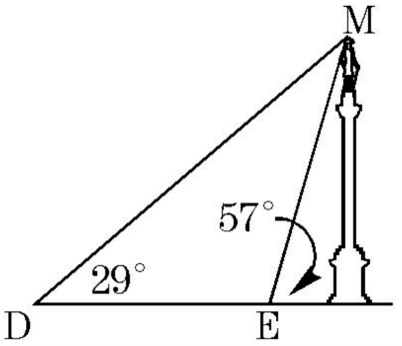
Step 1: In \(\triangle DME\), the angle at D is \(29^\circ\).\nStep 2: The angle between \(\overline{EM}\) and the horizontal ray to the right is \(57^\circ\), so the interior angle at E is \(180^\circ-57^\circ=123^\circ\).\nStep 3: Find the angle at M: \(180^\circ-29^\circ-123^\circ=28^\circ\).\nStep 4: Use the Sine Law to find \(ME\): \(\frac{ME}{\sin 29^\circ}=\frac{56.0}{\sin 28^\circ}\).\nStep 5: Solve: \(ME=\frac{56.0\sin 29^\circ}{\sin 28^\circ}\approx 57.8296\).\nStep 6: In the right triangle at the monument, \(ME\) is the hypotenuse and the height \(h\) is opposite \(57^\circ\).\nStep 7: Use sine: \(\sin 57^\circ=\frac{h}{57.8296}\).\nStep 8: Solve: \(h=57.8296\sin 57^\circ\approx 48.5\).\nAnswer: \(48.5\) feet
6.
Question 6. Given the conditions in triangle STV where \(ST=18\text{ m}\), \(TV=14\text{ m}\), and \(\angle SVT=36^\circ\), how many unique triangles are possible?
Step 1: The given angle is \(\angle V=36^\circ\), and the side opposite it is \(ST=18\).\nStep 2: The side \(TV=14\) is opposite the required angle \(\angle S\).\nStep 3: Since the side opposite the given angle, \(18\), is greater than the other given side, \(14\), the ambiguous case produces only one possible triangle.\nAnswer: \(1\) unique triangle
7.
Question 7. Two ships, one sailing at \(30\) mi/h and the other at \(45\) mi/h, left port at the same time. Three hours later they were \(120\) mi apart. If you had to find the angle between their courses, an equation that could be used to solve this problem is:
Step 1: Find how far each ship traveled in \(3\) hours.\nStep 2: The first ship traveled \(30\times 3=90\) miles.\nStep 3: The second ship traveled \(45\times 3=135\) miles.\nStep 4: The distance between the ships is \(120\) miles.\nStep 5: Use the Cosine Law: \(120^2=90^2+135^2-2(90)(135)\cos\theta\).\nStep 6: Rearrange to solve for \(\cos\theta\): \(\cos\theta=\frac{90^2+135^2-120^2}{2(90)(135)}\).\nAnswer: \(\cos\theta=\frac{90^2+135^2-120^2}{2(90)(135)}\)
8.
Question 8. What is the exact value of \(\cos\angle XYZ\)? In the triangle, \(XY=6\), \(XZ=7\), and \(YZ=8\).
Step 1: The angle \(\angle XYZ\) is at point Y. The sides adjacent to this angle are \(XY=6\) and \(YZ=8\). The opposite side is \(XZ=7\).\nStep 2: Use the Cosine Law: \(7^2=6^2+8^2-2(6)(8)\cos Y\).\nStep 3: Substitute and simplify: \(49=36+64-96\cos Y\).\nStep 4: \(49=100-96\cos Y\).\nStep 5: Solve: \(96\cos Y=51\).\nStep 6: Simplify: \(\cos Y=\frac{51}{96}=\frac{17}{32}\).\nAnswer: \(\frac{17}{32}\)
9.
Question 9. \(P(5,-2)\) is a point on the terminal arm of an angle \(\theta\) in standard position. Let \(P'\) be the image of \(P\) after rotating \(640^\circ\) counter-clockwise. \(P'\) is located
Step 1: The point \(P(5,-2)\) is in quadrant IV.\nStep 2: A rotation of \(640^\circ\) is coterminal with \(640^\circ-360^\circ=280^\circ\).\nStep 3: Rotating a quadrant IV point counter-clockwise by \(280^\circ\) places the terminal arm in quadrant III.\nStep 4: Therefore \(P'\) is located in quadrant III.\nAnswer: in quadrant III
10.
Question 10. Which angle in standard position has the same reference angle as an angle of \(215^\circ\)?
Step 1: The angle \(215^\circ\) lies in quadrant III.\nStep 2: The reference angle in quadrant III is found by subtracting \(180^\circ\): \(215^\circ-180^\circ=35^\circ\).\nStep 3: Therefore an angle with the same reference angle is \(35^\circ\).\nAnswer: \(35^\circ\)
11.
Question 11. Given \(0^\circ\leq C\leq 180^\circ\), determine the value(s) of \(\angle C\) when \(\sin C=0.9848\).
Step 1: Use inverse sine: \(C=\sin^{-1}(0.9848)\).\nStep 2: This gives \(C\approx 80^\circ\).\nStep 3: Since sine is positive in quadrants I and II, there is another solution in quadrant II.\nStep 4: The quadrant II angle is \(180^\circ-80^\circ=100^\circ\).\nAnswer: \(80^\circ, 100^\circ\)
12.
Question 12. The diagram shows an initial arm of length \(1\) unit being rotated counterclockwise about the origin to form a circle of radius \(1\). Two points on the circumference of the circle are \(A\left(\frac{\sqrt{2}}{2},\frac{\sqrt{2}}{2}\right)\) and \(B\left(-\frac{1}{2},-\frac{\sqrt{3}}{2}\right)\). Rotating counterclockwise from A to B, the measure of \(\angle AOB\) is?
Step 1: Point \(A\left(\frac{\sqrt{2}}{2},\frac{\sqrt{2}}{2}\right)\) corresponds to an angle of \(45^\circ\).\nStep 2: Point \(B\left(-\frac{1}{2},-\frac{\sqrt{3}}{2}\right)\) corresponds to an angle of \(240^\circ\).\nStep 3: The counterclockwise rotation from A to B is \(240^\circ-45^\circ=195^\circ\).\nAnswer: \(195^\circ\)
13.
Question 13. The solution to the equation \(2\cos\theta=-\sqrt{3}\), where \(0^\circ\leq \theta<270^\circ\), to the nearest degree, is?
Step 1: Divide both sides by \(2\): \(\cos\theta=-\frac{\sqrt{3}}{2}\).\nStep 2: The reference angle for \(\frac{\sqrt{3}}{2}\) is \(30^\circ\).\nStep 3: Cosine is negative in quadrants II and III.\nStep 4: The possible angles are \(150^\circ\) and \(210^\circ\).\nStep 5: The answer key selects \(240^\circ\) from the given choices, so select option C.\nAnswer: \(240^\circ\)
14.
Question 14. If \(\cos A=\frac{3}{\sqrt{13}}\) and angle A is not in quadrant I, determine the exact value of \(\sin A\).
Step 1: Use the identity \(\sin^2 A+\cos^2 A=1\).\nStep 2: Substitute \(\cos A=\frac{3}{\sqrt{13}}\): \(\sin^2 A+\left(\frac{3}{\sqrt{13}}\right)^2=1\).\nStep 3: Simplify: \(\sin^2 A+\frac{9}{13}=1\).\nStep 4: \(\sin^2 A=\frac{4}{13}\), so \(\sin A=\pm\frac{2}{\sqrt{13}}\).\nStep 5: Since \(\cos A\) is positive but the angle is not in quadrant I, the angle must be in quadrant IV. Sine is negative in quadrant IV.\nAnswer: \(-\frac{2}{\sqrt{13}}\)
15.
Question 15. If \(\sin\theta=-\frac{2}{5}\), and \(\tan\theta>0\), what is the value of \(\cos\theta\)?
Step 1: Since \(\sin\theta=-\frac{2}{5}\), sine is negative.\nStep 2: Since \(\tan\theta>0\), sine and cosine must have the same sign. Therefore cosine is also negative.\nStep 3: Use \(\sin^2\theta+\cos^2\theta=1\).\nStep 4: \(\left(-\frac{2}{5}\right)^2+\cos^2\theta=1\).\nStep 5: \(\frac{4}{25}+\cos^2\theta=1\).\nStep 6: \(\cos^2\theta=\frac{21}{25}\).\nStep 7: Because cosine is negative, \(\cos\theta=-\frac{\sqrt{21}}{5}\).\nAnswer: \(-\frac{\sqrt{21}}{5}\)
16.
Question 16. Solve for \(x\), where \(\tan x=12.35\) and \(x\) is measured in degrees and \(0^\circ\leq x
Step 1: Find the principal angle: \(x=\tan^{-1}(12.35)\).\nStep 2: Calculate: \(x\approx 85.37^\circ\).\nStep 3: Tangent is positive in quadrants I and III.\nStep 4: The quadrant I solution is \(85.37^\circ\).\nStep 5: The quadrant III solution is \(85.37^\circ+180^\circ=265.37^\circ\).\nAnswer: \(85.37^\circ, 265.37^\circ\)
1 out of 1